Friday, August 1, 2008

Bigaa, how Vigan got its name


Image courtesy of http://k53.pbase.com

How Vigan got its name is told from an anecdote carried by the tongue of generations, which tells of a Spaniard walking along the banks of the Mestizo River. There, he met a native of the place and stopped to inquire: “Como se Ilama usted de esta lugar?”

Not understanding a word of Spanish, the native scratched his head and upon seeing that the Spaniard was pointing to a plant, exclaimed in Ilocano: “Bigaa Apo”. Bigaa being Alcasia Macroniza, a giant Taro plant belonging to the Gabi family which used to thrive at the bank of the Mestizo River. From the name of the plant – Bigaa, whence Vigan derived its name. Source: http://www.santa.gov.ph/ilocossur/cmviganhistory.html

The Founding of Vigan


(Image courtesy of http://es.geocities.com/losconquistadoresespanoles/)
In the book, The Philippine Island, Vol. III, p. 276, Blair and Robertson, two letters of Governor General Guido de Lavezares to King Philip II of Spain mentions: “It seemed best to send Captain Juan de Salcedo with 70 or 80 soldiers to people the coast of Los Ilocano on the shores of the river called Bigan.” Salcedo then sailed from Manila on May 20, 1572 and arrived in Vigan on June 12, 1572.

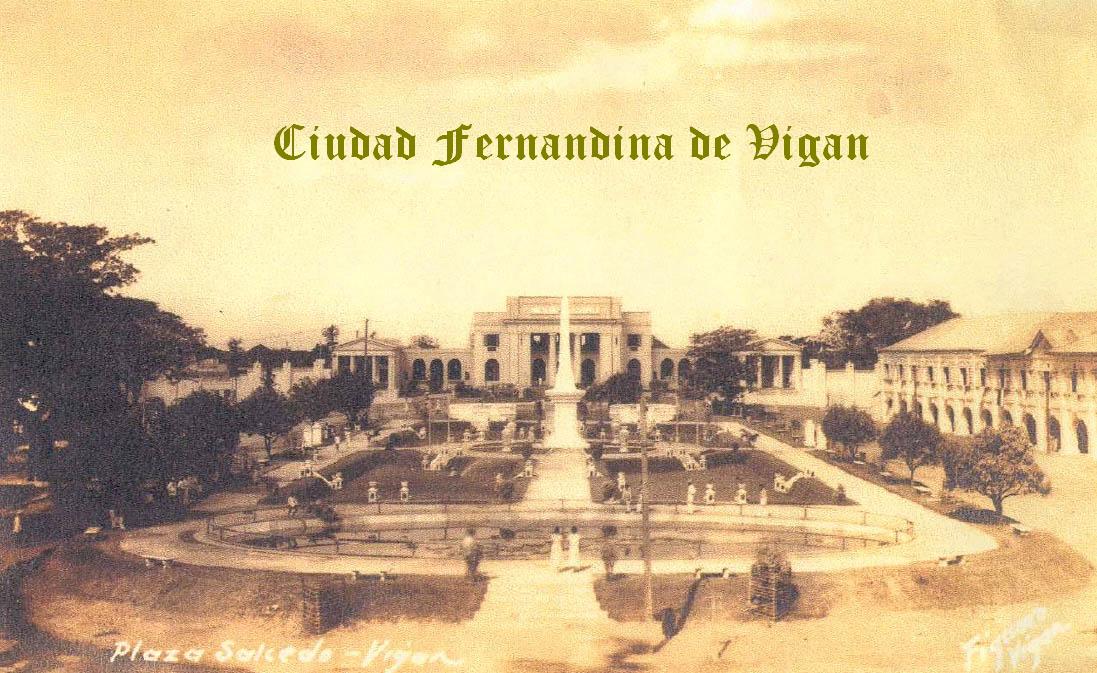
Thus, after the successful expedition and exploration of the North, Don Juan de Salcedo founded “Villa Fernandina de Vigan” in honor of King Philip II’s son, Prince Ferdinand who died at the tender age of four. From Vigan, Salcedo rounded the tip of Luzon and proceeded to pacify Camarines, Albay, and Catanduanes.

As a reward for his services to the King, Salcedo was awarded the old province of Ylocos which then composed of the Ilocos Norte, Ilocos Sur, Abra, La Union and some part of Mountain Province as his Encomienda and was accorded the title as Justicia Mayor de esta Provincia de Ylocos.


In January 1574, Salcedo returned to the capital of his Encomienda, Vigan, bringing with him some Augustinian Missionaries to pioneer the evangelization of Ylocos and established a Spanish city, for the purpose of controlling the neighboring country.

Governor General Gomez Perez Dasmarinas, in his Account of Encomienda dated in Manila on May 31, 1591 states: “The town of Vigan called Villa Fernandina has five or six Spanish citizens with one priest, a Justice, one Alcalde Mayor (Governor) and a Deputy. The King collects 800 tributes (equivalent to 3,200 subjects). During this period, the old Vigan was composed of 19 barrios.

In 1645-1660, Vigan was already divided into 21 Cavezas de Barangay as mentioned in the “Libro de Casamiento”, the oldest records of the parish house of Vigan found in its Archives. Separated from the naturales, the Chinese have their own place of settlement called pariancillo, “Los Sangleyes del parian” and the Spaniards were residents in a villa called “Los EspaƱoles de la Villa”.
Source: http://www.santa.gov.ph/ilocossur/cmviganhistory.html

The Vigan Song


Vigan, Naidumduma a Lugar ti Amianan

(Vigan, a place like no other in the North)

-written and composed by Elpidio Lopez Palapala**

I

Umaykan gayyem ditoy siyudad ti Vigan/

Natalna ken napintas inda ap-apalan/

Uray sadino man lugar nga inka naggappuan/

Madadaan kami a makipagayam

II

Ditoy Vigan laeng ti inka pakakitaan/

kadaanan a balbalay napnuan pakasaritaan/

Ta isu dayta ti inna naglatakan/

Ditoy pagilian ken ti sangalubungan

Koro

Agkaykaysa tay ngarud ta intay saluadan/

Siyudad ti Vigan a kapipintasan/

Ta daytoy ket gameng a kapapatgan/

Nga intay ipatawid sumaruno a kaputotan

III

Adu met ti bannuar maitangsit iti Vigan

Da Apo Quirino kenni Diego Silang

Leona Florentino Mannaniw ti Kailokuan

ken Padre Burgos Martyr a kasingpetan

IV

Siyudad ti Amianan ken inka pakasarakan

Pagaramidan ti burnay ken abel ti kailokuan

Longganisa, empanada, naimas a makmakan

Ken tay kalesa napintas a pagluganan (Koro)

V

Ti Vigan laeng nabati a nagtaengan

Dagiti kastila immay ditoy pagilian

RUmbeng ngarud nga intay aywanan

Ta maipagtangsit uray sadino man (Koro)


...Nga intay ipatawid sumaruno a kaputotan

VIVA VIGAN!